Product overview
Details that help confirm the fit.
The Gas Burner Electrode is a ceramic-insulated combustion component designed for ignition or flame-ionisation sensing in compatible gas burner systems.
When used as an ignition electrode, the component receives high voltage from the ignition transformer and produces a spark between the metal tip and the burner head or a second electrode. The spark ignites the gas-and-air mixture during the burner start-up sequence.
When used as a flame-sensing electrode, the metal rod detects the presence of a stable flame through the flame-ionisation principle. The resulting flame signal is transmitted to the burner controller, which allows the gas valves to remain energised during normal operation.
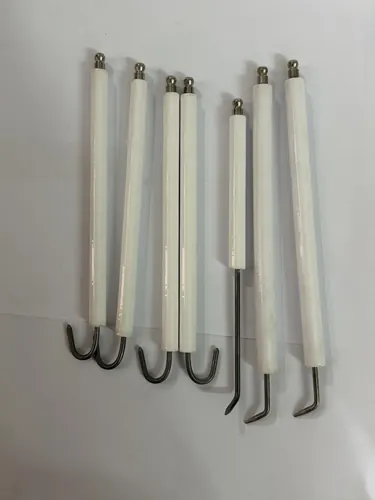
The long white ceramic insulator electrically isolates the metal conductor from the burner body. The ceramic construction also provides resistance to the elevated temperatures present around the combustion head.
Different electrode-tip shapes are used to suit the burner’s combustion-head geometry. Curved and hooked tips support spark positioning near the gas outlet, while right-angle tips can be positioned within compact combustion-head assemblies.
The upper metal terminal provides a connection point for the high-voltage ignition cable or flame-signal lead. Correct terminal engagement is important for reliable electrical operation.
Accurate electrode positioning is essential for dependable ignition and flame supervision. Incorrect spacing, damaged ceramic insulation or contact between the electrode and burner head can cause weak sparking, delayed ignition, flame-signal loss or burner lockout.
Typical applications include natural-gas and LPG burners installed on commercial and industrial boilers, steam boilers, hot-water boilers, furnaces, ovens, hot-air generators, radiant-tube heaters and process-heating systems.
The replacement electrode must match the original length, ceramic diameter, terminal style, tip shape and mounting position. Installation, electrode adjustment, ignition testing and flame-signal measurement should be performed by qualified burner-service personnel.
Model, voltage, rotation, pressure range and mounting can vary. Final compatibility is confirmed against the nameplate or existing component.